
The heating, ventilation, and air conditioning (HVAC) industry is undergoing its most significant technological transformation in over two decades. Driven by environmental regulations aimed at reducing greenhouse gas emissions, manufacturers, technicians, and property owners are transitioning away from long-standing hydrofluorocarbon (HFC) refrigerants like R-410A.
In its place, R-454B has emerged as the primary low Global Warming Potential (GWP) refrigerant choice for central air conditioners, heat pumps, and light commercial climate control systems across North America.
This transition is mandated by federal climate legislation and international environmental treaties. Because R-454B belongs to a distinct safety classification known as A2L (mildly flammable), it introduces fundamental changes to HVAC system design, installation procedures, safety protocols, and long-term equipment servicing.
This comprehensive guide details the chemical and thermodynamic profile of R-454B, explains the regulatory timeline driving the phase-down of older refrigerants, outlines safety engineering changes in modern HVAC systems, and breaks down the practical financial and operational impacts for homeowners and property managers.
1. The Regulatory Catalyst: The AIM Act and EPA Mandates
The transition to R-454B is governed by the American Innovation and Manufacturing (AIM) Act, enacted by the United States Congress. The AIM Act granted the Environmental Protection Agency (EPA) full regulatory authority to execute a phased phase-down of production and consumption of high-GWP hydrofluorocarbons by 85 percent relative to baseline levels.
Under the EPA's Technology Transitions Rule, specific GWP limits were established for residential and commercial heating and cooling equipment:
- Maximum GWP Threshold: Effective for equipment manufactured, newly manufactured residential and light commercial central air conditioning and heat pump systems must utilize refrigerants with a GWP of 700 or less.
- Phase-out of R-410A: Because R-410A carries a GWP of approximately 2,088, it exceeds the federal threshold by nearly three times, rendering it non-compliant for newly manufactured systems.
- Global Alignment: This federal transition aligns with the international Kigali Amendment to the Montreal Protocol, designed to curb global average temperature increases by phasing down potent synthetic greenhouse gases.
While legacy refrigerants like R-22 were phased out primarily to protect the stratospheric ozone layer, the shift away from R-410A focuses on climate change mitigation. R-454B delivers equivalent cooling performance while drastically reducing atmospheric thermal retention in the event of a system leak.
2. Chemical and Thermodynamic Profile of R-454B
R-454B is a zeotropic refrigerant blend engineered to mirror the operational pressures and cooling capacities of R-410A while minimizing environmental persistence.
Chemical Composition
R-454B is marketed under trade names such as Opteon XL41 and consists of a precise formulation combining two distinct chemical compounds:
- R-32 (Difluoromethane): Comprising 68.9 percent of the blend by weight. R-32 provides high thermodynamic capacity, strong thermal conductivity, and efficient heat transfer.
- R-1234yf (2,3,3,3-Tetrafluoropropene): Comprising 31.1 percent of the blend by weight. R-1234yf is a hydrofluoroolefin (HFO) that significantly lowers the overall Global Warming Potential of the mixture.
Environmental Comparison
The primary metric evaluating environmental impact is Global Warming Potential, which measures how much energy one ton of a atmospheric gas absorbs over a 100-year period relative to one ton of carbon dioxide ($\text{CO}_2$, which has a baseline GWP of 1).
- R-410A Global Warming Potential: $\text{GWP} = 2,088$
- R-454B Global Warming Potential: $\text{GWP} = 466$
By switching to R-454B, the HVAC industry achieves a 78 percent reduction in Global Warming Potential compared to legacy R-410A equipment. Neither R-410A nor R-454B contains chlorine, meaning both carry an Ozone Depletion Potential (ODP) rating of zero.
Thermodynamic Efficiency
From a mechanical performance standpoint, R-454B matches or slightly exceeds the efficiency of R-410A. It operates at similar working pressures, exhibits low temperature glide (less than 1.5 degrees Fahrenheit), and offers superior discharge temperatures and critical point performance.
This allows compressor manufacturers to maintain compact coil geometries while improving seasonal energy efficiency ratios (SEER2) and heating seasonal performance factors (HSPF2).
3. Decoding the A2L Safety Classification
The most significant change accompanying R-454B is its safety rating under ASHRAE Standard 34 (Designation and Safety Classification of Refrigerants).
Historical residential refrigerants such as R-22 and R-410A were classified as A1 (non-toxic and non-flammable). In contrast, R-454B is classified as A2L (non-toxic, mildly flammable, low burning velocity).
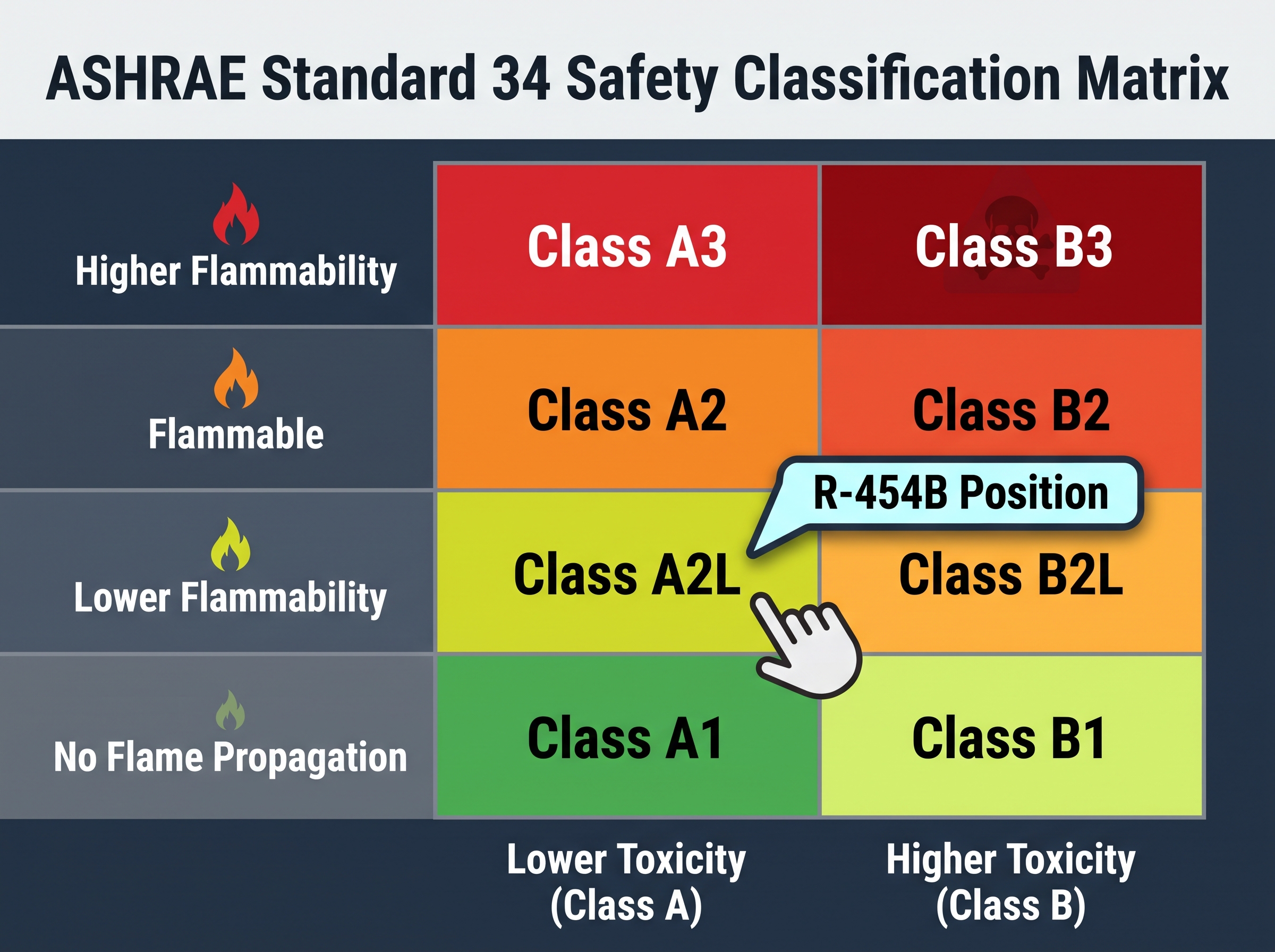
Understanding what the A2L classification actually means helps dispel common misconceptions regarding safety:
The "A" Designation (Lower Toxicity)
Like R-410A, R-454B carries a Class A toxicity rating. It is non-toxic under normal operating conditions and poses no chemical health risk to building occupants during standard operation or routine service.
The "2" Designation (Flammability)
Class 2 indicates that the gas can ignite under specific atmospheric conditions when mixed with air in precise concentrations.
The "L" Designation (Low Burning Velocity)
The "L" designation is the most critical element of the A2L classification. It signifies a low maximum burning velocity, defined as less than 10 centimeters per second ($<10\text{ cm/s}$).
In practical terms, R-454B is difficult to ignite and sustained combustion requires a continuous, high-energy open flame source (such as a direct brazing torch). It will not ignite from common household sources like static sparks, light switches, electrical outlets, or hot surfaces below its auto-ignition temperature of over 1,400 degrees Fahrenheit ($760^\circ\text{C}$).
If an ignition source is removed, an A2L flame front naturally extinguishes rather than producing an explosive force.
4. Hardware and Safety Engineering in A2L HVAC Equipment
To accommodate the mild flammability of A2L refrigerants, equipment manufacturers (including Carrier, Trane, Lennox, Rheem, and York) have redesigned indoor air handlers, coils, and outdoor condensing units to meet updated UL 60335-2-40 safety standards.
Modern R-454B residential HVAC systems incorporate active safety mitigation systems directly into their cabinet design:
R-454B System Active Safety Sequence
1. Leak Detection: Sensor detects refrigerant concentration reaching 25% of Lower Flammability Limit.
2. Signal Transmission: A2L Control Board isolates power to outdoor compressor and ignition sources.
3. Active Mitigation: Indoor Blower Fan turns on automatically at maximum speed.
4. Gas Dissipation: High-velocity airflow dilutes refrigerant concentration into living space well below ignition levels.
1. Integrated Refrigerant Detection Systems (RDS)
Indoor air handler units now feature factory-installed refrigerant leak sensors located adjacent to the evaporator coil. These sensors continuously sample air inside the cabinet for airborne hydrocarbons.
2. Automated Active Mitigation Logic
If a leak occurs and the sensor detects refrigerant concentration reaching 25 percent of the Lower Flammability Limit (LFL), the integrated A2L control board instantly initiates an automated safety protocol:
- It disconnects electrical power to the outdoor compressor unit to halt the flow of refrigerant.
- It energizes the indoor blower fan at full speed, circulating air through the ductwork to dilute and dissipate the escaping refrigerant safely throughout the structure, preventing localized gas pooling.
3. Sealed and Spark-Proof Electrical Controls
Internal switches, relays, contactors, and fan motor controls within A2L equipment are fully sealed or certified spark-proof to eliminate potential internal ignition points.
4. Reverse-Thread Service Access
Refrigerant recovery cylinders and service equipment designed for R-454B feature left-handed (reverse) threaded fittings and distinct red safety bands to prevent accidental cross-contamination with A1 refrigerants or non-rated service equipment.
5. Non-Compatibility and Legacy Equipment Management
A critical technical reality for homeowners and facility engineers is that R-454B is strictly non-compatible with legacy R-410A systems.
Why Retrofitting Is Not Permitted
R-454B cannot be dropped into an existing R-410A unit, nor can R-410A be charged into a new R-454B system. Attempting to mix these refrigerants or retrofit legacy equipment violates federal law, voids manufacturer warranties, and presents serious mechanical and safety hazards due to:
- Incompatible Lubricating Oils: R-454B requires specific synthetic polyolester (POE) lubricants formulated with specialized additive packages to ensure proper compressor oil return.
- Different Expansion Valve Calibrations: Thermostatic expansion valves (TXV) and electronic expansion valves (EEV) are calibrated for specific mass flow rates and thermal properties.
- Lack of Safety Controls: Legacy R-410A indoor air handlers lack the required leak detection sensors, spark-proof electrical enclosures, and active mitigation control boards mandated for A2L equipment.
Impact on Existing R-410A System Owners
If your home or building currently uses a functional R-410A air conditioner or heat pump, there is no requirement to replace your system immediately.
- Continued Serviceability: Federal EPA regulations permit the continued servicing, repair, and maintenance of installed legacy R-410A systems for the duration of their natural operational lifespans.
- Component Availability: Equipment manufacturers continue to produce replacement parts, compressors, motors, and indoor coils designed for existing R-410A field repairs.
- Refrigerant Supply Trends: While virgin R-410A production is decreasing under the AIM Act phase-down schedule, reclaimed and recycled R-410A remains available for field service. However, as the supply of virgin R-410A contracts, the per-pound cost of legacy refrigerant will rise over time.
6. Financial and Operational Impacts on Property Owners
The transition to R-454B alters both the initial purchase economics and the operational care of residential and commercial climate control systems.
Equipment Purchase Price Trends
Newly designed R-454B HVAC equipment carries a higher initial manufacturing cost compared to legacy R-410A systems. This price variance stems directly from added hardware components:
- Integrated A2L leak detection sensors and dedicated mitigation logic circuit boards.
- Redesigned microchannel or enhanced copper evaporator coils engineered for lower total refrigerant charge volumes.
- Sealed electrical contactors and variable-speed blower assemblies meeting UL 60335-2-40 standards.
While upfront equipment costs are higher, modern R-454B systems deliver higher seasonal energy efficiency (SEER2) ratings, lowering monthly electrical consumption and partially offsetting initial capital expenditures over time.
Contractor Training and Certification
Servicing A2L equipment requires specialized training. Professional HVAC contractors must invest in upgraded, spark-proof tools specifically rated for A2L refrigerants, including:
- A2L-compliant dual-stage vacuum pumps and digital manifold gauges.
- Non-sparking refrigerant recovery machines.
- Electronic leak detectors calibrated specifically for R-32/R-1234yf molecular structures.
- Flame-free press-fit copper joining tools (such as zoomlock or pro-press fittings) to reduce open-flame brazing inside residential structures.
Homeowners should verify that their servicing contractor holds current A2L Refrigerant Safety Certification through recognized industry bodies such as NATE (North American Technician Excellence) or ESCO Institute.
7. Comparative Technical Matrix: R-410A vs. R-454B
The table below summarizes the key chemical, environmental, safety, and operational differences between legacy R-410A and next-generation R-454B refrigerants:
8. Decision Framework: Repairing vs. Replacing Your HVAC System
If you are faced with a major repair decision on an aging climate control unit, use this structured framework to determine whether to maintain your existing equipment or upgrade to an R-454B platform:
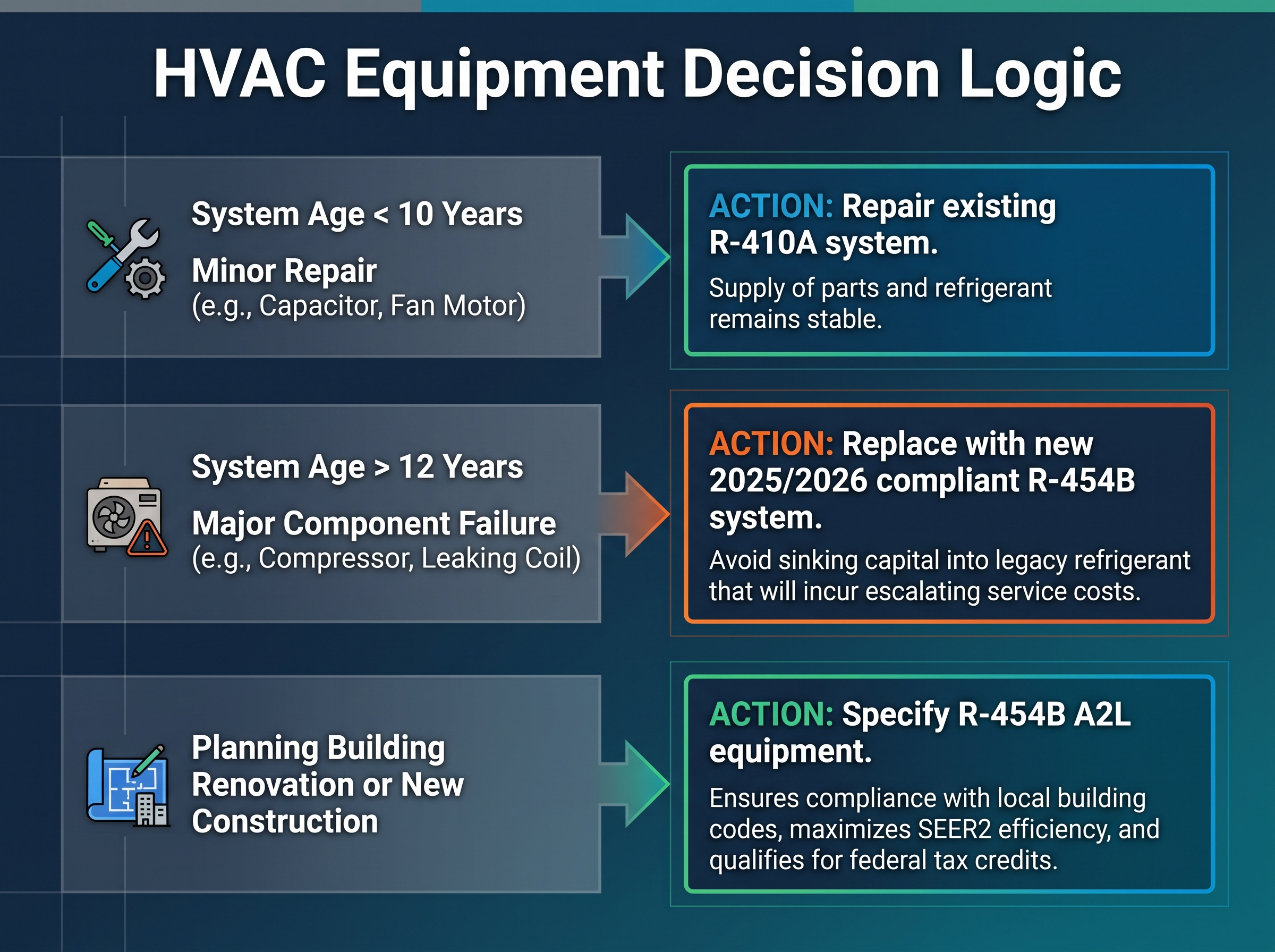
higher seasonal energy efficiency (SEER2) ratings
Key Questions to Ask Your HVAC Contractor
When evaluating a system replacement or major service, ask your technician these four diagnostic questions:
- "Is your service team fully certified in A2L refrigerant handling and safety protocols?"
- "Does the proposed equipment quote include a factory-certified AHRI match sheet for A2L compliance?"
- "Does my existing electrical panel have adequate breaker capacity to support the A2L indoor control board and air handler?"
- "What federal Section 25C tax credits or local utility rebates apply to this specific low-GWP equipment installation?"
Contact us now for a free estimate
Navigating the Future of Home Climate Control
The transition to R-454B represents a deliberate, technology-driven evolution toward environmentally responsible heating and cooling. By replacing high-GWP hydrofluorocarbons with A2L refrigerants, the HVAC industry dramatically reduces its carbon footprint while delivering higher operational efficiency.
While existing R-410A systems remain fully legal to operate and service, all new residential and light commercial equipment installations now utilize low-GWP refrigerants like R-454B.
Understanding the safety features, chemical properties, and service requirements of R-454B empowers property owners to make informed, cost-effective decisions when maintaining, repairing, or upgrading their home comfort systems.


